
For Hope and Healing
For I am not ashamed of the Gospel of Christ, for it is the power of God to salvation for everyone who believes (Romans 1:16).


Roof Rack Update
Shane from LabRak, after an hour and a half at FedEx, was finally able to ship the Custom Designed 80-series Modular Roof Rack in 13 separate boxes. A few weeks ago I had a conversation on the phone with Shane, and with George and Nick from Expedition Lighting Systems (ELS). The two companies needed to work together as Shane would need to design custom mounts for the lights that would allow them to attach to his rack. The conference call went well, ELS shipped most of the lights to me in Germany, and then sent a few to Shane so he could design the mounts and any necessary spacers to ensure proper fit. The lights and rack will be wired and assembled by Taubenreuther GmbH.
To give you an understanding of the task facing Shane I will do my nest to describe the process. LabRak did not have a stock of racks for the 80-Series Land Cruiser (our model). So Shane, in just a few weeks (2 to be precise), needed to design a full sized roof rack, custom mounts (gutter variation), with trays for water and fuel, as well as the ability to mount a roof top tent. The design needed to be field/bush repairable (if necessary), and versatile enough to configure it and then reconfigure it for different purposes (overland travel – recovery vehicle – safaris). After designing the rack, he then had to outsource the manufacture of some of the parts that weren’t in stock due to their specific fit to the 80-Series.
Not only did Shane complete the design, he was also able to arrange the manufacture of new custom parts, and drive the timeline of the manufacturer to meet our schedule. Upon receipt of the parts, he didn’t just throw them in a box and ship them as quickly as possible; he remained cool, and kept me informed. Shane spent a number of late nights assembling and reassembling the rack, removing rivets and replacing them with bolts and thread lock nuts, and putting reinforced joints where he thought necessary. He also configured the rack in a variety of ways, took pictures of the different options and sent them to me via email to review and select the best for our needs. At the end of these time consuming builds he had created a very strong, very rigid, and spacious rack that met all of our requirements.

- Shane removed the rivets and replaced them with bolts and thread lock nuts to ensure that the rack is field repairable. He also included extra parts. Photo Courtesy LabRak
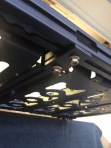
- The support beam for the seven jerry can mounts. This beam also allows us to stack other items on the rack and has tie down eyes attached on top. Photo Courtesy LabRak
The rack can be mounted with the can carriers on the front or the back, and can have a roof top tent mounted to either end. Sounds like no big deal considering most other rack companies can do the same thing. The difference I am seeing thus far is that the design is completely different from any other rack on the market. Rather than being a fabricated rack that is mass produced and then later adapted by the end user, LabRak creates custom racks up front to ensure all that is necessary is mounting. The rack is of a modular design, which means that it can be modified in size, attachment points and types, and has the ability to integrate (not just attach) different, very robust mounts for other tools.
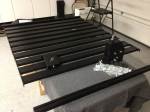
- Photo Courtesy LabRak
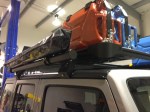
- Here, the rack has an awning mount as well as Jerry Can holders. Photo Courtesy LabRak
An example is the jerry can holders integrated into the rack design. Rather than having holders that attach to the surface of the rack planks, this design places the mounts a as part of the rack, and they are attached lower in the rack frame to reduce drag and lower the weight that is placed on the roof. An individual mount is solid, low profile, and secured by a large latch that swings over the can and locks into place with a cotter pin tethered to the mount. A second pin is tethered to the can and holds the cap in place. Our rack has seven jerry can mounts across its entire width. Between the fourth and fifth mount is a bar that increases support and the rigidity of the rack. It also has tie down eyes that allow us to stack other items, such as firewood, in place of the cans, and then tie them down with straps. It is quite a versatile system.
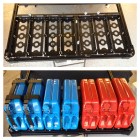
- Seven cans across. Photo Courtesy LabRak

- Jerry Can mounts. Photo Courtesy LabRak
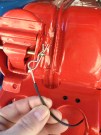
- The cotter pin and tether for the Jerry Can caps. Photo Courtesy LabRak

- Cotter pin and tether for the Jerry Can mount latch. Photo Courtesy LabRak
In addition to the can holders there is also a mount for a shovel, and a very nicely designed Hi-Lift jack mount. Shane also designed and included a fishing rod holder, and added a rod sleeve designed and sewn together by his mother. I thought that was a very nice personal touch.
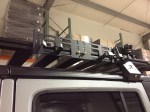
- The Hi-Lift roof rack mount. Photo Courtesy LabRak
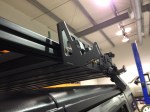
- Side view of the Hi-Lift mounting system. Photo Courtesy LabRak

- Jack attachment hardware. Photo Courtesy LabRak
LabRak didn’t stop there, in addition to the mounting hardware and rack, they included a variety of extra parts, differing sizes of light mounts, and spacers and adapters. Over all, their attention to detail, and quality of service and support has been outstanding. Shane had this to say, “I want you to know that I am committed to you, the cause and everything you represent. So over the year I’ll keep you in the loop on new products and do what I can to make sure you have the newest gear.”
We appreciate the tireless effort Shane put into designing, manufacturing, and shipping of our rack. He did this with a charitable heart and we hope to see his business succeed over the coming years. When the rack arrives and Taubenreuther mounts it, we will provide more pictures as well as photos of the completed truck build. In addition, we will gives future updates on rack quality, mount quality, service quality, and detailed reports on the use of each item.

- Boxed and ready for shipment. Photo Courtesy LabRak
Fuel Tank
Fuel is an item, along with food and water, that determines how far you can go and for how long you can be gone before having to resurface into the civilized world. With fuel, though, your options are limited, as you can hunt and fish for food and purify lake, stream, or mud hole water to quench your thirst. The recommended range for one fill-up when crossing Africa is 1000 kilometers or 620 miles, but this is general advice. “If you have any remote routes in mind, upgrading to a typical 1000km/620-mile range can give you peace of mind. (Scott)” I found similar advice on the Land Cruiser Club Southern Africa site as well as stories to match. Rather than follow general advice I am finding it best to check the route and see distances between cities especially when crossing empty desert. For example, it is 964 km from Wadi Halfa, Sudan to Khartoum Sudan. If we have 1000km worth of fuel we basically cannot get off the improved surface as driving through sand and over other terrain can double your fuel consumption. Another example is the Central Kalahari; it is roughly 900km from Sevuti/Chobe back to South Africa and nearly all of that is on deep sand tracks. When Massi and I did the trip this distance, done with main, auxiliary, and three jerry cans depleted all of our fuel supply, and that was without getting stuck. Had we fouled up even one time it is possible that we wouldn’t have completed the trip. This is why I think that proper planning; carrying proper gear, and having proper training and ability are all necessary.

- Sand track – Central Kalahari

- Google Maps – Chobe to Khutse Game Reserve
I am heeding the 1000 km general rule, but will plus-up a bit so that if I want to get stuck I can. I have what Toyota calls an 85l tank that I have never been able to get more than 75l in. If there is another 10l in it, I have not been willing to drive it to empty though the needle has settled square on the E. Taubenreuther is adding a 166l auxiliary tank made by The Long Ranger company out of Australia. This tank is custom designed for the 80-series Land Cruisers and is fit into the undercarriage in the rear of the truck where the spare tire sits. For this application it is necessary to find a new home for the spare which will be moving to a carrier on the rear bumper. The positive aspects of this setup are that I can fill the truck with enough fuel to carry me well over 1000km, the added weight is low in the vehicle, and it is hidden so that I get less flack at borders where fuel prices rise sharply. The negative aspect of the setup is that nearly all of my fuel is in one container. Though I have a paraffin test kit and a water separating funnel/filter if I foul up and forget to use them then all of the fuel is contaminated and can’t be filtered like it could from a jerry can. The other problem, which I have ordered protection for, is puncture damage. This is where background and focus come together. If you need a spotter, use one. If you have to get out to see and pick your line, do it. Be aware of your vehicle clearance and watch where you put your tires. If one slips off a rock at the right moment, it or another rock could puncture the tank. Though it is stainless steel, set in higher than the differentials/axles and in the rear of the truck I still have to pay attention when driving over unimproved surfaces, especially rocks.
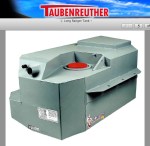
- The 166l Long Ranger tank for 80-series Land Cruisers
I still plan to carry jerry cans and water cans, though. There are many benefits to having a stock of them. For one, fuel can be filled and filtered or decanted at a later time. Also, fuel in cans is easier to share than the fuel in an auxiliary fuel tank. This is my main reason for carrying them, as I want to be able to assist other adventurers and locals who may be stranded and need some fuel. Additionally, and empty fuel can is easier to carry than a truck is to push. While I don’t think it is wise in all situations to walk, you never know what you may have to do. I just like being prepared and having more than one option.
As I mentioned above, I am carrying a paraffin test kit and a water separating fuel funnel/filter. I received many warnings concerning fuel distributed from Nigeria. “The two worst enemies IMHO will be diesel contaminated with water, and diesel mixed with paraffin. The first you can avoid by using a water trap funnel filter (such as the Racor range from turboformance) when filling up (or decanting from your jerry can) while the second is not so much of a problem and can be circumvented by putting some two stroke oil in your tank with the diesel. (Denkema)” The Nigerians add a considerable amount of paraffin to the fuel and sell it. While engines will run on it, the paraffin will eventually destroy the engine and will definitely shorten the life of fuel filters. The paraffin test kit was sold by United Diesel and is a density test. If the fuel does not meet European Standard EN590 diesel density specification the the black pellet in the jar floats to the surface indicating fuel mixing. The funnel I purchased from Woick in Germany. It is designed to trap water and other contaminants as the fuel is poured or pumped into the tank or other container.
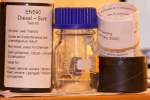
- Paraffin Test kit

- Fine mesh that traps water – Funnel
1. Scott, Chris; 2011; “Overlanders’ Handbook: Worldwide Route and Planning Guide, Car, 4WD, Van, Truck; Trailblazer Publications, pg 212.
2. Denkema, Jaco; http://www.landcruiserclub.co.za/cms/index.php?name=Forums&file=viewtopic&t=56726
Motivation
It’s interesting how things can surprise you sometimes. I received a Skype call this evening from a young lady named Lara Tabbara. She called from the U.S. to ask a few questions about the trip. She had seen one of the press releases on the Internet and was curious to know if I was following through with the planning, and whether I would consider traveling through other areas such as the Middle East or India. The answer is yes. I have found that there are good and bad people in the world, but the majority are good people trying to make a life just like you and me. Lara is quite positive and enthusiastic and her words of encouragement and the excitement in her voice were motivating. Sometimes we do things that others question, frown upon, or discourage us from doing. It is a ray of sunshine when a stranger calls and cheers for you and displays genuine excitement for you and your mission. So Lara, thank you very much, and I raise a glass to you and your coming adventures. Listen to reason, hear advice, do a risk assessment and then don’t stop pushing until you reach your goals and fulfill your dreams. Chris
Chatfind

Flag Counter
Syrepu

 For Hope and Healing